





The effect of Mycorrhizal Fungi inoculation on the growth rate of Eucalyptus Grandis seedlings at SA Fine-Tuned nursery in Stutterheim

Mini dissertation by Inathi Kwezi submitted to the Department of Forestry & Natural Resources at Fort Cox for her Advanced Diploma in Forestry Management. Supervised by Angel A Goldsmith.
Forestry contributes significantly to South Africa’s economy, providing raw materials for domestic and international markets. Among many species, Eucalyptus grandis is valued for its rapid growth, adaptability, and high-quality wood (1).
However, plantation forestry depends on the supply of vigorous seedlings from nurseries. Thus, the growing interest in Arbuscular Mycorrhizal Fungi (AMF) for improving seedling performance.
AMF forms symbiotic relationships with plant roots, enhancing nutrient uptake, improving water-use efficiency, and supporting root development (2). While the benefits are well-documented globally, their application in South African nurseries remains underexplored.
Research aim and objectives
The aim of this study was to evaluate the effects of AMF inoculation on the early growth of Eucalyptus grandis seedlings under nursery conditions in Stutterheim.
Objectives:
- Quantify the effects of mycorrhizal fungi inoculation on seedling growth parameters above ground and below ground
- Evaluate the extent of mycorrhizal colonisation in the roots of inoculated seedlings and investigate its relationship with early root development and overall seedling growth development
Method
A completely randomised design was used, consisting of three treatments:
- Non-inoculated control
- Moderate inoculum rate (250g AMF per 25 L growing medium)
- High inoculum rate (500g AMF per 25 L growing medium).
Each treatment was replicated four times, with each replicate consisting of a single nursery tray planted with 100 seeds. The result was 1,200 seeds across all treatments. A one-way ANOVA was used to assess significant differences among treatments.
Results
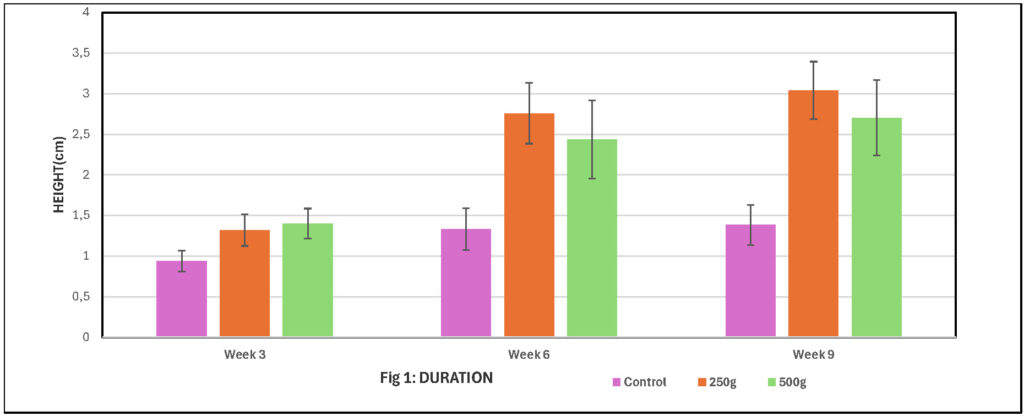
The average seedling height is shown in Figure 1. After nine weeks, the 250g treatment consistently achieved the greatest height, reaching 3.0cm, followed by the 500g treatment at 2.7cm. The control treatment was the lowest, remaining nearly stagnant at 1.4cm (p < 0.05).
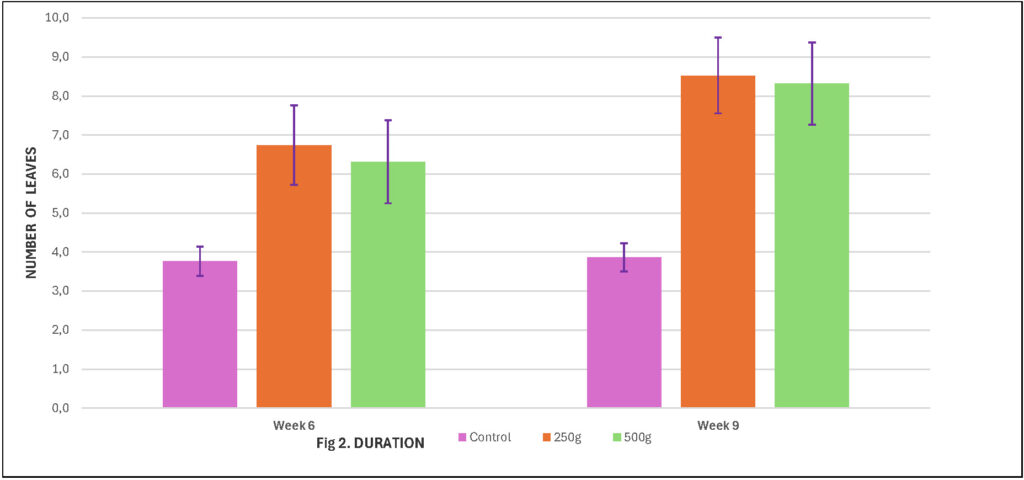
Figure 2 shows the average leaf count after nine weeks. The 250g treatment remained the highest, with nine leaves, closely followed by the 500g treatment, with eight leaves, while the control treatment remained at four leaves (p < 0.05).
Figure 3 indicates that seedlings from the 250g treatment exhibited a more fibrous and extensively lateral-branched root system, suggesting improved soil exploration capacity. The 500g treatment also showed increased root density compared to the control, but exhibited signs of reduced root elongation.
Figure 4 depicts the average root length across all treatments. The 250g treatment recorded the longest mean root length, followed by the control, while the 500g treatment showed the shortest average root length. Although quantitative differences in root length were small, qualitative observations indicated markedly higher root density in inoculated treatments.

Discussion
These results demonstrate that mycorrhizal fungi inoculation positively influences the early growth of Eucalyptus grandis seedlings, with effects that vary with inoculum concentration.
The initial height growth advantage observed in the 500g treatment may be linked to rapid nutrient availability during early stages. However, its decline relative to 250g treatment over time suggests that excessive inoculum results in increased metabolic demand or competition within the root zone.
Similar trends have been reported by Wu et al. (3), in which growth benefits diminished at higher colonisation levels. The sustained performance of the 250g treatment indicates that moderate inoculation supports efficient nutrient exchange and long-term growth.
Leaf development followed a similar pattern, with both inoculated treatments outperforming the control, confirming the role of AMF in enhancing nutrient uptake. However, the limited difference between the 250g and 500g treatments suggests a threshold for additional inoculum foliar growth.
Although root length differences were minimal, increased root density in the inoculated treatments indicates improved root architecture and nutrient-absorption capacity. This is consistent with findings by Gao et al (4), who reported enhanced lateral root branching in AMF-inoculated plants.
Conclusion & recommendations
The findings demonstrate that while AMF inoculation can enhance early seedling development, its effectiveness is highly dependent on application rate. Moderate inoculation created favourable conditions for sustained growth, whereas excessive application introduced stress and limited overall performance.
- Apply AMF at moderate levels: A rate of 250g per 25 litres of growing medium is recommended for Eucalyptus grandis nursery production.
- Avoid over-application: Higher rates (500g) may increase stress and mortality, particularly in less controlled environments.
- Optimise nursery conditions: Consistent watering, adequate light, and stable greenhouse conditions are essential to maximise AMF benefits.
- Support further research: Future trials should include improved replication, mortality tracking, and direct measurement of root colonisation.
Acknowledgements
I would like to express my sincere gratitude to the following institutions and persons:
- Fort Cox Agriculture and Forestry Training Institute for providing me with the opportunity to undertake this research.
- The Fibre Processing and Manufacturing Seta (FP&MSeta) for funding support.
- My research supervisor, Angel A Goldsmith.
- SA Fine-Tuned Forestry for granting permission to conduct the study at their nursery in Stutterheim and for their cooperation during the research period.
- Merensky Timber and Nomvuyiso Tshangisa for in-kind donation of trial material.
- My family and friends for their continued encouragement, understanding, and support.
References
- Myburg AA, Grattapaglia D, Tuskan,GA, Hellsten U, Hayes RD, Grimwood J, Jenkins J, Lindquist E, Tice H, Bauer D, Goodstein, DM, (2014). “The genome of Eucalyptus grandis”. Nature, 510(7505), pp356-362.
- Smith SE & Read DJ, (2010). Mycorrhizal Symbiosis. 3rd ed. London: Academic Press.
- Wu Y, Chen CJ & Wang G, (2024) “Inoculation with arbuscular mycorrhizal fungi improves plant biomass and nitrogen and phosphorus nutrients: A meta‑analysis”, BMC Plant Biology, 24:960.
- Gao X, Li Q, Chen Y, et al (2023). “Individual and combined effects of arbuscular mycorrhizal fungi on root growth and nutrient absorption”, Frontiers in Plant Science 14, p1140267.


